THE APPROACH
How this work
thinks
We are living through a period of profound transition. Artificial intelligence is reshaping work and knowledge, while climate instability, biodiversity loss and social fragmentation are changing how we live with one another and with the living world.
We cannot respond to systemic challenges with fragmented thinking.
THE GUIDING QUESTION
The question behind the work
How can learning help people recognise relationships, navigate complexity and contribute to flourishing futures?
THE CONDITION
The way we learn shapes the way we see
Education and organisational learning are often organised into separate subjects, functions and areas of expertise. This makes it difficult to recognise the relationships, patterns and consequences that shape real-world challenges.
The challenge is not simply a lack of information. It is our capacity to see the whole while understanding the relationships within it.
The way we learn shapes how we think. And the way we think shapes the systems we create.
— Soumi Duttagupta · Founder, Regenesys
WHAT THIS LEADS TO
When relationships remain unseen
01 | Knowledge remains fragmented
Connections across disciplines and functions are easily missed.
02 | Problems are addressed at the surface
Visible events receive attention while underlying patterns remain unchanged.
03 | Linear solutions are applied to complex challenges
Interdependence, feedback and changing conditions are overlooked.
04 | Decisions create unintended consequences
An intervention in one part of a system produces effects elsewhere.
05 | Complex problems persist
Responses change, but the underlying way of thinking does not.
TWO WAYS OF THINKING
Systems thinking and regenerative thinking
Why Systems Thinking?
Systems thinking helps us recognise relationships, patterns, feedback and unintended consequences.
Why Regenerative Thinking?
Regenerative thinking asks how those relationships can be strengthened so that people, communities and living systems can flourish.
THE BRIDGE
From fragmentation to connection
The Regenesys approach brings these ways of thinking into learning and leadership, helping people move from isolated responses towards greater systems awareness and more connected action.
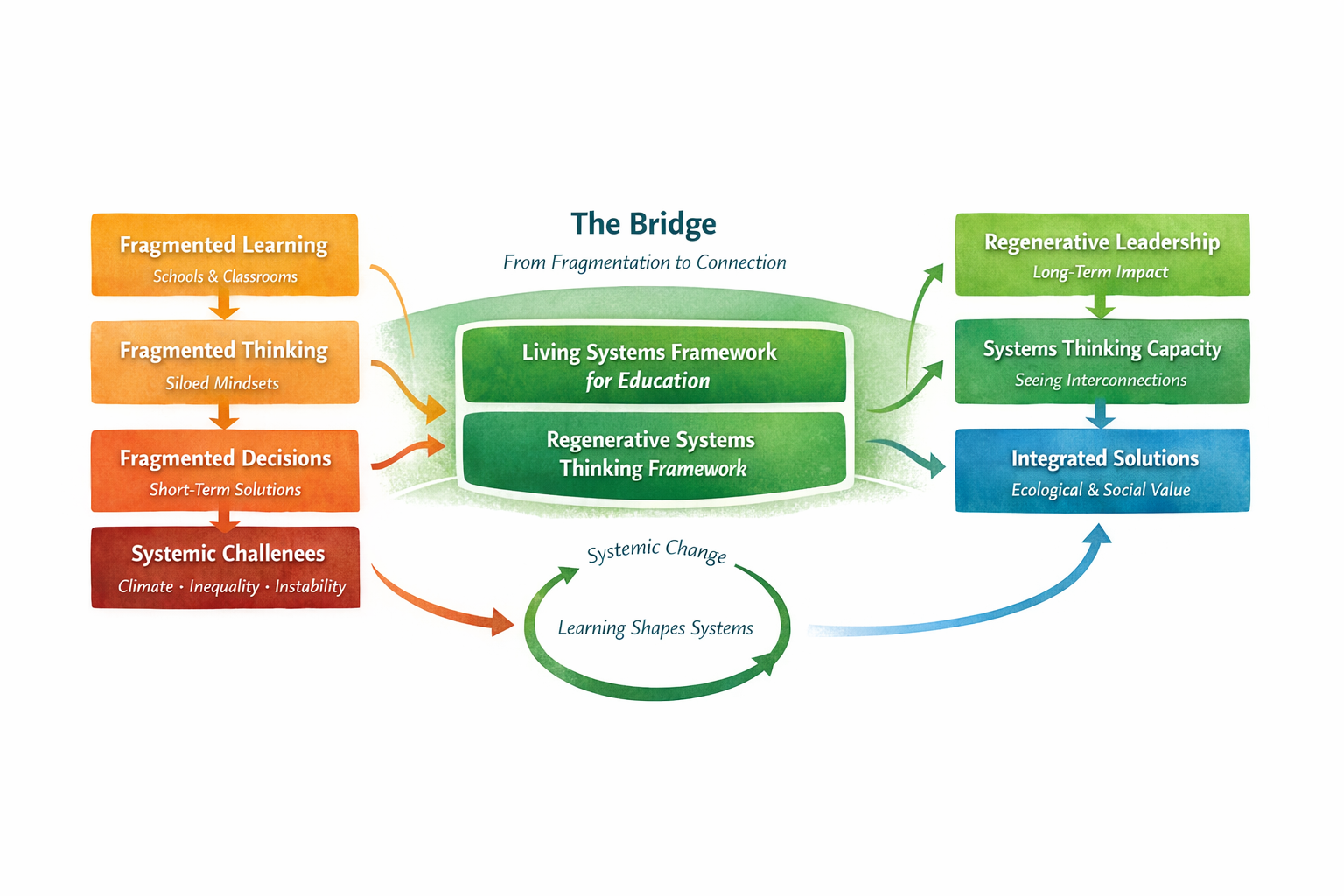
Learning shapes systems. Systems shape learning.
The way this shift happens will differ across schools, universities and organisations because each is a living system shaped by its own people, relationships, purpose and place.
WHAT THIS IS NOT
Important distinctions
This is not environmental education added to the curriculum
This is not a content delivery programme
This is not a one-time intervention
This is not a fixed model applied in the same way everywhere.
It is a relational and adaptive approach shaped by the context in which people learn, lead and make decisions.
Learning for a world of relationships
Explore the learning experiences, workshops and applications shaped by the Regenesys approach.